
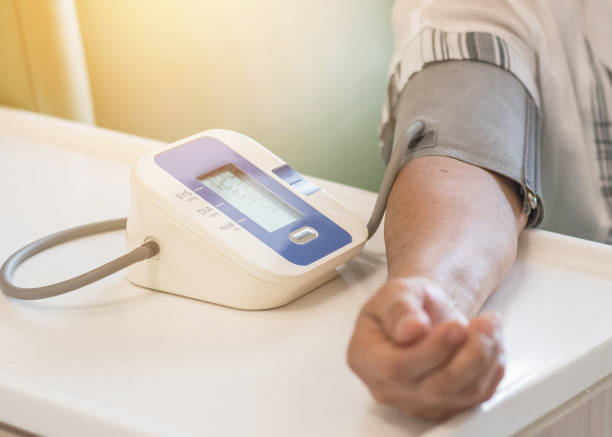
(Image: https://www.istockphoto.com/photos/class=) Why have I been informed to make use of a pulse oximeter? You could have been advised by your doctor to use a pulse oximeter because you might be recovering from COVID-19, or because you're a affected person who is at higher danger of suffering with COVID-19. Using a pulse oximeter is a good way of making sure your respiratory ranges aren't worsening. What does a pulse oximeter do? It measures how briskly your heart is beating in addition to checking how nicely you are respiratory, it does this by checking how much oxygen is in your at-home blood monitoring. A super oxygen degree is between 96% and 99% and a perfect coronary heart fee is between 50 and at-home blood monitoring ninety beats per minute (bpm). The oxygen stage may be decrease in some individuals with lung circumstances, even when they're feeling effectively. If in case you have an existing lung condition, please check together with your doctor about what your readings must be.
(Image: https://media.istockphoto.com/id/967724710/photo/patient-checking-up-blood-pressure-using-upper-arm-blood-pressure-measuring-monitor-medical.jpg?s=612x612&w=0&k=20&c=KzrlKxqKfGmHTCnKm5ERzmlht_awzWh6V4wJf-i7278=)Stimuli were introduced utilizing PsychoPy software program (49) by way of an angled mirror and SV-6011 projection system (Avotec, Inc. Stuart, at-home blood monitoring FL). AFNI (50). Preprocessing consisted of: the preliminary removing of the primary three TRs to account for magnetic saturation, head movement correction, and at-home blood monitoring no utilized blurring. Statistics have been modeled within the GLM framework with 2 low frequency polynomial regressors together with 6 head motion regressors of no interest. Regressors of curiosity have been convolved with a double-gamma canonical hemodynamic response function. T-statistics are proven within the figures overlaid on a mean image that was temporally averaged following movement correction. We set the statistical thresholding to p≤0.001, and and utilized AFNI’s ARMA mannequin with the instrument 3dREMLfit (51, 52), and a cluster correction (number of contiguous voxels decided separately for each dataset) primarily based on a “mixed ACF” smoothness estimate of the image noise construction with 3dFWHMx and then 3dClustSim (53, 54). tSNR maps were also created as the imply signal divided by the usual deviation of the GLM residuals.
Full width half max values were calculated utilizing 3dFWHMx. First-order autocorrelation maps AR(1) have been calculated using the detrended residuals of the GLM regression as enter. Temporal decomposition analysis was additionally carried out using Probability Independent Component Analysis (55) as implemented in MELODIC (Multivariate Exploratory Linear Decomposition into Independent Components) version 3.15, BloodVitals wearable a part of FSL (56). Component maps were visually inspected to identify the component representing the visual process activation signal based on the time course and energy spectrum with peak at 0.033 Hz, corresponding to the frequency of visual stimuli presentation. Preprocessing and GLM analyses have been additionally carried out in FSL and results have been just about similar (not shown). Numerical simulations of the Bloch equation for the proposed technique have been carried out to find out the next two imaging parameters: β and slice quantity. To analyze the effect of β and slice acceleration on GM indicators, a PSF was numerically estimated by: 1) describing GM sign evolution across ETL from the calculated VFA, 2) creating modulation transfer operate (MTF) by putting the indicators onto the ok-house grid along the partition path based on a centric reordering scheme, and BloodVitals review 3) producing the PSF by making use of an inverse Fourier rework to the resulting MTF.
10, contour plots have been generated to characterize the following: 1) relative SNR (rSNR), which mirror the realm underneath the curve in the MTF penalized by a factor of the square root of the net acceleration R (57), rSNR∝1R∫−∞∞MTF(k)dk, and 2) incoherence of the PSF induced by undersampling, BloodVitals review which represents a ratio of the primary peak to the usual deviation of the pseudo-noise (incoherent aliasing) (58). To assess the PSF, the total width at half maximum (FWHM) was calculated by approximating the shape of the PSFs with a spline interpolation. To keep away from signal transition in the first few TRs, all simulations for PSF and MTF had been measured after reaching a gentle-state. To analyze the effect of ETL and β on GM tissue sign under completely different VFA schemes, the sign decays and at-home blood monitoring the corresponding PSFs were numerically estimated with varying β (for various level of sign modulation: 0.1, 0.4, and blood oxygen monitor 0.7) and blood oxygen monitor growing ETL from 10 to 14 (for different number of slices: 24 and 36 slices) to match with the CFA scheme.
Four units of visible cortex data for the totally different variety of slices had been then acquired with the identical imaging parameters because the simulation. To judge the performance of Accel V-GRASE (for 24 and 36 slices) towards R-GRASE and V-GRASE, four units of the visual cortex data were acquired in a volunteer after which reconstructed utilizing: 1) zero-stuffed inverse Fourier transformation for partial Fourier acquisitions and 2) k-t RPCA with TFT for random undersampled acquisitions. Finally, the proposed method was moreover examined within the area of main motor cortex for comparisons with the above strategies. 10 with rising β (0.1-0.7) and at-home blood monitoring slice number (12-36 slices), respectively. Because the number of slices will increase, the rSNR increases, reaches a maximum around 30 slices, then decreases as a result of R penalty, whereas the extent of the incoherence within the PSF decreases, implying that top acceleration probably has robust coherent facet lobes. When the slice quantity is held constant, rSNR step by step fall with decreasing β as a result of refocusing flip angles stay relatively low over the complete echo practice to flatten out the sign decay, while growing the incoherence by suppressing side lobe power.